

MUSE Guide Notes

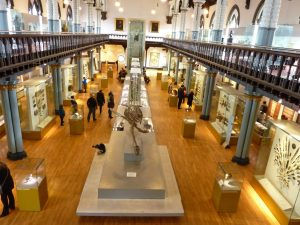
This is my script for a tour of the main gallery in the Hunterian Museum at the University of Glasgow. If you are interested about the Museum Student Educator program also see my post, Curator in the Making!
Museum Highlights, 2019
Intro
· My name and course
· Muse program
· General Info: Tour length, ask questions,
· Hunter
Minerals
· Just a small selection- collection holds over 120,000 examples of minerals as well as 1,5000 cut gems
· Collection comes from a variety of sources including William Hunter
· Some minerals can grow into geometric forms: known as crystals (e.g. no. 10)
· Pyrite aka fool’s gold, Crystal of iron sulphite (FeS2) (no. 2)
· Cubes like this are more likely to form in conditions with low temperature and low concentrations in the rock of iron and sulphur
Diploducus leg cast
· Sauropod from the Jurassic era. They had very long necks, long tails, small heads, and four thick, pillar-like legs. Weighed about 10 tonnes.
· This is a replica of Dippy the Dinosaur’s leg.
· Likely ate by stripping branches of trees.
· The leg tells us that this dinosaur moved around a lot. To eat, reproduce, and escape from predators.
Bearsden Shark
· Found by fossil hunter Stan Wood whilst walking his dog by a burn in Bearsden, the north of Glasgow, in 1982.
· 330 million years old, lived during the carboniferous period
· Proper name of Akmonistion Zangerli, a compression fossil of a shark with a fin.
· Toothed fin behind its head has an unknown purpose. This fin is called a ‘dorsal fin’ called a ‘spine-brush complex’.
· So well preserved you can see its blood vessels and remains of its last meal
Lady Shepenhor
· Over 2500 years old from Thebes (Theobes) in Southern Egypt
· Spelling of Osiris (Oseyeruss): ‘new’ way, so must be after 700 BC
· The hieroglyphs on the brightly painted coffin are spells and charms to keep her safe.
· The body of a mature female, about 1.47 m (4 ft 10 in) in height
· Central column is a standard formula which is meant to allow the deceased to access food or anything else left by family members
· Text specifies the name Shepenhor, however the coffin has been opened in the past, so we don’t know if the mummy inside is the original.
Chinese Map- not on display (currently in the Hunterian Art Gallery) but still give some facts
· Kwuhn-oO chooen-toO (kunyu quantu) or Full Map of the World
· Produced by Ferdinand Verbiest in 1674 who was a Jesuit Missionary from Flanders and became scientific advisor to the Kangxi emperor: Director of the Imperial Observatory
· As well as cartography, Verbiest’s skills included astronomy, geometry, philosophy and music. Add to this his diplomacy and fluency in a range of languages including Latin, German, Spanish and Hebrew
· Printed from woodblocks, the map was part of a larger geographical work called Kunyu tushuo (Illustrated Discussion of the Geography of the World), which included information on different lands as well as the physical map itself.
· Modelled on previous work by the Italian Matteo Ricci, also a missionary in China
· Blend of Eastern and Western Maps
Cleopatra Coin
· Cleopatra’s Life
- Married her brother while young
- During a conflict with Rome, met and became lovers with Caesar
- Was consequently exiled by her brother but Caesar helped her regain the throne
- Later married Mark Antony
- Most of her rule was a prosperous one for Egyptians
- At the end of her life was captured by the Roman Emperor Octavian
- Died by snake bite, many accounts say she committed suicide to escape captivity.
· Coin description: coin of Cleopatra VII (51- 30 BC). Heads show the bust of Cleopatra whilst Tails, or the reverse side, shows Eagle standing left on thunderbolt with “cornucopiae”. “horn of plenty”
· 80 drachma: drachma was one of the world’s earliest coins. Its name derives from the Greek verb meaning “to grasp”, and its original value was equivalent to that of a handful of arrows.
- An ancient Greek currency unit issued by many Greek city states during a period of ten centuries, from the Archaic period throughout the Classical period, the Hellenistic period up to the Roman period under Greek Imperial Coinage
· Coin is internationally famous as being one of the best portraits of Cleopatra
The Clachaig Skull
· From the Neolithic period (C. 4000-2500BC)
· Excavated from the cairn at Clachaig falls on Arran in 1900
· Part of Thomas Hastie Bryce’s collection who was a lecturer in Anatomy at the university.
· Found alongside the remains of 14 men, women and children.
Plesiosaur
· Reptile that lived in the sea during the Middle Jurassic Period (160 million years ago).
· Had a long neck and strong front fins which helped it to swim fast and catch prey.
· Plesiosaurs ate cephalopods (sefalopods), like ammonites which were marine molluscs, and small fish and became the dominant marine reptile of the Jurassic and Cretaceous periods.
· These reptiles are often found in Jurassic rocks in England and were about four and a half meters long.
· This one was excavated at the beginning of the 20th century from a clay pit near Peterborough.
Serpent Instrument
· Part of Professor Bernard Hague’s collection (1893-1960)
· He came to the University of Glasgow in 1923 and became the James Watt Professor of Electrical Engineering in 1946 until 1960.
· He was an accomplished oboist and was a member of the University Orchestral Society and was Governor of the Royal Scottish Academy of Music for fifteen years.
· He collected and repaired over 70 wind instruments dating from the late C18th onwards.
· The serpent is a bass wind instrument, descended from the cornett, and a distant ancestor of the tuba, with a mouthpiece like a brass instrument but side holes like a woodwind.
· It was invented in 1590 by Edme Guillaume, a French canon of Auxerre.
· Made of wood in a serpentine curve 7 to 8 feet long, and it has a conical bore and six finger holes.
· Accompanied plainchant in churches; from the 18th century until it was superseded by brass basses in the C19th. It was also a standard wind bass in military bands.
· Produces a rich tone and a wide dynamic range. As a Euphonium player, the two sound very similar to me.

Comments